
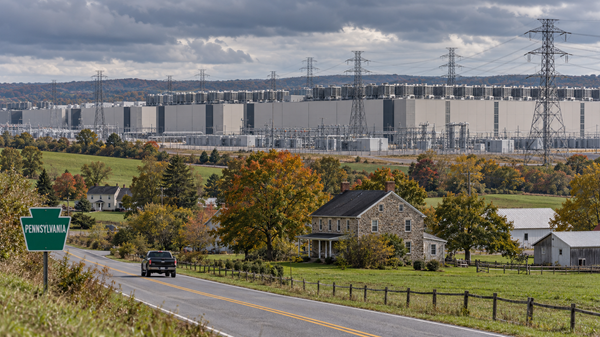
Data centers are spreading across Pennsylvania, from the former Homer City power plant site in Indiana County to proposed projects in suburban and rural communities. It is unlikely that a full moratorium on data centers would be successful, and there are legitimate arguments for allowing, even welcoming these facilities. There are benefits to having data centers in Pennsylvania, but there are also significant potential drawbacks.
This is the argument before local and state governments. Left to their own devices, data center builders would run roughshod over our citizens and towns. However, with proper governance and with citizens having a voice, data center growth can be controlled, regulated and taxed to provide benefits to people and not just to the companies building them and the technology companies behind the builders.
The strain on the electric grid
Pennsylvania households are already struggling with electricity bills. Large new industrial customers can add to demand on the regional power grid, increasing pressure for new power generation and transmission lines. Data centers are not the sole cause of higher rates, and the size of their contribution is contested. But decisions about who pays for infrastructure built to serve them will directly affect the bills of ordinary customers.
A sensible policy starts with a straightforward principle: if a company needs expensive new electrical infrastructure, residential ratepayers should not be expected to subsidize it. Similarly, communities deserve meaningful information about water consumption, environmental consequences, and emergency power generation before a project is approved.
Harrisburg’s incomplete response
Lawmakers introduced dozens of proposals in 2026, including requirements that large electricity users cover more of their own costs, restrictions on passing speculative project costs to consumers, and measures to improve public disclosure.
Yet July’s state budget produced only one major statutory data-center measure: facilities above a specified electricity-use threshold must report energy and water consumption. A sales-tax exemption for data-center equipment, projected by Spotlight PA to reduce state revenue by roughly $2 billion through mid-2031, remained in place.
That’s a disappointing result for families who are being asked to accept higher utility costs while major corporations receive substantial tax advantages. Support for economic development should not mean writing a blank check.
Shapiro has begun setting conditions
In August, Governor Shapiro issued an executive order establishing additional requirements for new data-center proposals. Under his administration’s framework, developers seeking the state’s more favorable permitting and tax treatment are expected to pay the full costs of infrastructure needed for their projects, engage communities early, support local workers, and meet environmental and water-conservation standards.
The order also removes data centers from the state’s fast-track permitting program and links eligibility for the existing tax exemption to compliance with the new requirements.
These steps represent a meaningful shift toward protecting residents rather than simply competing to attract the biggest corporate investments. They are not, however, a substitute for legislation. Executive actions have limits, and future administrations can change them.
Local communities deserve a seat at the table
For residents, the issue may be even more immediate than electricity prices. Data centers can transform land use, affect water supplies, require substations and transmission upgrades, and reshape the character of a community.
Local governments have important roles in zoning and land-use review, but state energy and environmental policy determines much of the framework they operate within. Residents should have a meaningful opportunity to question the developers, review the likely effects, and insist on enforceable commitments rather than promises.
The choice in November
Pennsylvania should not have to choose between technological investment and affordable electricity, or between new jobs and responsible environmental stewardship. It can demand both.
That requires elected officials willing to establish clear rules: corporations pay the costs their projects create; communities receive transparent information; workers and municipalities share in the benefits; and taxpayers are not asked to underwrite private profits without a demonstrable public return.
Shapiro’s recent actions move in that direction. But lasting protections will depend on the next governor and on who controls the House and Senate. We could lose and ground we’ve made in this fight the wrong choice. So this November you can help make the decision: continue on a road that leads to smart investment in technology and the future based on the best-interests of all Pennsylvanians, or throw away that progress and take our chances with politicians that will leave the most consequential decisions to the companies themselves.
Check voting information at pa.gov/agencies/vote.




 Connect with us on Signal